Shadow Stack
thirty years of stack exploitation history, and why this defense is finally different
Buffer overflow defenses keep getting bypassed. Shadow stack is the first one that attacks the root problem: it keeps a hardware-protected copy of return addresses that regular code literally cannot overwrite.
mice vs cats
Every defensive mechanism in exploit development has been bypassed. Not eventually. Usually within weeks. The history of stack exploitation is not a story of defenders winning. It is attackers adapting faster than anyone expected.
The thread: DEP, ret2libc, ASLR, ROP, stack canaries, format strings, shadow stack.
Understanding why each defense failed is the only way to understand why shadow stack is different.

chapter 1: the history
the classic overflow
Before any mitigations, a stack buffer overflow was trivially exploitable. Overflow the buffer, overwrite the saved return address, point it at shellcode, function returns, shellcode executes.
high address
┌────────────┐
│ return addr│  ← attacker overwrites this
├────────────┤
│ saved rbp  │
├────────────┤
│ local vars │
├────────────┤
│ buffer[64] │  ← overflow starts here
└────────────┘
low address
The attacker needed the stack to be executable. That assumption lasted until 2004.
DEP / NX (2004)
Data Execution Prevention marks the stack non-executable. The CPU enforces this via the NX bit in page table entries. Attempt to jump into stack shellcode and you get a hardware exception.
It worked briefly. Then ret2libc appeared.
ret2libc bypass: instead of jumping to shellcode on the stack, jump to existing executable code in memory, specifically system() in libc. Overwrite the return address with the address of system(), set up the stack to pass /bin/sh as an argument. DEP does not care: you are jumping to legitimate code, not the stack.
DEP was dead within a year.
ASLR (2005)
Address Space Layout Randomization randomizes the base addresses of the stack, heap, and loaded libraries on each run. Even if you want system() in libc, you do not know where libc is loaded.
Entropy on 32-bit systems: ~16 bits (65536 possibilities). Average brute-force: 32768 attempts. On a local service that respawns instantly, this is minutes. ASLR on 32-bit is security theater.
On 64-bit, entropy is ~28 bits. Harder but not impossible:
- Info leaks: any vulnerability leaking a pointer (use-after-free, format string) gives you a base address. Add the known offset. ASLR defeated.
- Partial overwrites: overwrite just the lower bytes of a return address. ASLR does not randomize page offsets, so you can redirect within the same library.
- Heap spray: fill memory with your payload at enough locations that guessing where it lands becomes practical.
stack canaries (2001, widespread ~2010)
A canary is a random value placed on the stack between the buffer and the saved return address. Before returning, the function checks it is intact. If not, the program terminates.
┌────────────┐
│ return addr│
├────────────┤
│ saved rbp  │
├────────────┤
│  canary    │  ← checked before ret
├────────────┤
│ local vars │
├────────────┤
│ buffer[64] │
└────────────┘
Bypasses:
- Format string leaks:
printf(user_input).%08xwalks up the stack and leaks the canary. Overwrite it with the same value. - Heap overflows: heap has no canaries. Pivot to heap-based ROP.
- Non-contiguous overwrites: some vulns write to arbitrary offsets, skipping the canary.
- Fork brute force:
fork()servers inherit the parent canary. Brute-force one byte at a time: 256 guesses x 8 bytes = 2048 guesses total.
ROP (2007+)
Return-Oriented Programming does not inject code. It chains tiny snippets already in the binary, “gadgets”, each ending in ret.
gadget 1: pop rdi; ret
gadget 2: pop rsi; ret
gadget 3: call system
Load "/bin/sh" into rdi, NULL into rsi, call system(). No injected shellcode. ROP works against DEP and, with an info leak, against ASLR.
This is where the arms race stalled for years.

chapter 2: shadow stack
Shadow stack attacks ROP at its root: the fact that a function’s return address can be corrupted.
the mechanism
When a function is called, the hardware does two things:
- Pushes the return address onto the normal stack
- Also pushes the return address onto a separate, hardware-protected shadow stack
On return, the hardware compares the return address on the normal stack against the shadow stack. If they differ, control flow violation, the processor faults.
                 normal stack              shadow stack
call foo() →    [ret addr: 0x401050]   [ret addr: 0x401050]
                [saved rbp          ]
                [locals             ]
                [buffer             ]   ← attacker overflows this

overflow →      [ret addr: 0xdeadbeef]  [ret addr: 0x401050]
                                                ↑
                                        mismatch → #CP fault
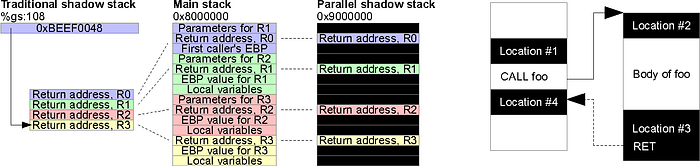
The shadow stack is mapped SHADOW_STACK. Normal store instructions cannot write to it. Only the SAVEPREVRSP/RSTORSSP instructions and the CPU call/ret microcode can touch it. A regular mov [shadow_stack_ptr], rax faults.
Intel CET
Intel shipped CET starting with Tiger Lake (11th gen, 2020). Two features:
- Shadow Stack (SS): protects return addresses
- Indirect Branch Tracking (IBT):
ENDBR64marks valid call/jmp targets. An indirect branch to any address not starting withENDBR64faults.
Windows 10 20H1+ enables shadow stack for user-mode processes. Linux support landed in 2023 via ARCH_SHSTK_* prctl flags.
# check kernel CET support
grep CET /boot/config-$(uname -r)

# enable shadow stack in your process (linux)
#include <sys/prctl.h>
#include <asm/prctl.h>
arch_prctl(ARCH_SHSTK_ENABLE, ARCH_SHSTK_SHSTK);
performance
Intel benchmarks: ~1-3% overhead on real workloads. Earlier software implementations (LLVM SafeStack) showed 3-9%. Hardware eliminates most of it. There is no longer a credible performance argument against enabling CET.
demo: seeing shadow stack block an overflow
the vulnerable program
// vuln.c
#include <stdio.h>
#include <string.h>

void win() {
    printf("[!] code execution redirected\n");
}

void vuln(char *in) {
    char buf[64];
    strcpy(buf, in);  // no bounds check, no canary
}

int main(int argc, char *argv[]) {
    vuln(argv[1]);
    return 0;
}
without protection
gcc vuln.c -o vuln -fno-stack-protector -no-pie -z execstack -O0
Find win():
objdump -d vuln | grep '<win>'
# 0000000000401136 <win>:
Overflow and redirect:
python3 -c "
import sys
payload = b'A' * 72 + (0x401136).to_bytes(8, 'little')
sys.stdout.buffer.write(payload)
" | xargs -0 ./vuln
# [!] code execution redirected
Works. The return address on the stack got replaced with 0x401136. vuln() returned there.
with shadow stack
gcc vuln.c -o vuln_cet -fcf-protection=full -fstack-protector-strong -O0
Same payload:
python3 -c "
import sys
payload = b'A' * 72 + (0x401136).to_bytes(8, 'little')
sys.stdout.buffer.write(payload)
" | xargs -0 ./vuln_cet
# Segmentation fault (core dumped)
Check in GDB:
(gdb) run $(python3 -c "print('A'*72 + '\x36\x11\x40\x00\x00\x00\x00\x00')")
Program received signal SIGSEGV, Segmentation fault.

(gdb) info registers rip
rip  0x401136

(gdb) x/gx $ssp
# holds the original return address into main, untouched
The CPU hit ret inside vuln(). Normal stack said 0x401136. Shadow stack said main+X. Mismatch. #CP fault raised. Linux delivered SIGSEGV. The function never completed the return.
ROP chain vs shadow stack
Without CET, a classic pwntools chain:
from pwn import *

elf = ELF('./vuln')
rop = ROP(elf)
rop.call('puts', [elf.got['puts']])
rop.call(elf.sym['main'])

payload = b'A' * 72 + rop.chain()
p = process(['./vuln', payload])
leak = u64(p.recvline().strip().ljust(8, b'\x00'))
log.info(f'libc leak: {hex(leak)}')
Against vuln_cet, every ret gadget triggers a shadow stack comparison. The chain dies on the first gadget because the return address on the normal stack does not match what was there when that frame was set up. You cannot write to the shadow stack from user code, so there is no way to repair it.
ENDBR64 and indirect branch tracking
Compile with IBT:
gcc vuln.c -o vuln_ibt -fcf-protection=branch -O0
Check the output:
objdump -d vuln_ibt | grep -A4 '<win>\|<vuln>\|<main>'
0000000000401136 <win>:
  401136:  f3 0f 1e fa    endbr64       # required marker at every valid target
  40113a:  55             push   rbp

0000000000401146 <vuln>:
  401146:  f3 0f 1e fa    endbr64
  40114a:  55             push   rbp
An indirect jump (jmp rax) to any address not starting with ENDBR64 raises #CP. Mid-function gadgets are eliminated. JOP chains have no valid landing pads.
Shadow stack (blocks ret chains) + IBT (blocks jmp/call chains) closes both main attack surfaces simultaneously.
chapter 3: remaining attack surface
Shadow stack breaks classical ROP. It does not eliminate exploitation.
JOP (Jump-Oriented Programming): chains gadgets ending in jmp or call. Shadow stack only protects return addresses. JOP is only blocked by IBT, and only if the binary was compiled with -fcf-protection=branch.
Heap corruption: shadow stack does not touch heap. Use-after-free, heap overflows, type confusion bugs are unaffected.
Logic bugs: shadow stack is a control-flow integrity mechanism. It says nothing about what a function does, only whether it returns to the right place.
TOCTOU / race conditions: entirely outside the threat model.
SSP corruption: the shadow stack pointer (SSP) is readable in user mode via RDSSPQ. If a kernel bug lets an attacker corrupt IA32_PL3_SSP, they can point the SSP at attacker-controlled memory. Not trivial, but not theoretical.
chapter 4: what’s next
CET/shadow stack hardens C/C++ programs by restricting how control flow can be corrupted. It does not prevent the underlying memory corruption that makes exploitation possible in the first place.
Rust eliminates the bug class at the source. No buffer overflow means nothing for shadow stack to protect.
The realistic outcome is not one or the other. Critical systems will run Rust. Legacy C/C++ codebases (the kernel, browsers, decades of infrastructure) will be protected by CET. Both are necessary and neither is sufficient alone.